
Selling in index heavyweights, including Infosys, TCS, ICICI Bank and Reliance Industries, dragged the benchmark indices into the negative for the second straight session, analysts said. Among the Sensex shares, Asian Paints fell the most by 3.9 per cent as analysts expressed concerns over rising competition in the domestic paints market following the entry of Aditya Birla group company Grasim Industries into the paints segment. IT shares Infosys, TCS, HCL Tech, Wipro and Tech Mahindra continued to slide amid inflation concerns in the US market.

The most consistent wealth creators since 2008 are all consumer-facing companies, says Devangshu Datta.

The fast-moving consumer goods (FMCG) sector has underperformed the Nifty over the past year as its 20 per cent return is trumped by 29 per cent of the benchmark index. The FMCG index saw a 2.2 per cent drop in the last session, while the Nifty lost 1 per cent. FMCG is seen as a defensive segment. The demand for staples like personal care products, groceries and snacks tend to be stable. FMCG companies are consistent dividend-payers.

US consumer confidence tumbled to a five-year low in March, disappointing economists and raising fears that the American economy could be heading into a deep recession. The Conference Board's confidence index fell from 76.4 in February 64.5 this month, compared with economists' expectations of a much lighter drop to about 74, as US consumers fretted over the deteriorating labour market and higher food and energy prices.

Lead indicators suggest that domestic current account deficit (CAD) is likely to reduce in 2023, while macro-economic stability has received a boost from inflation being brought back to the official tolerance band, according to the Reserve Bank of India's (RBI's) January 2023 Bulletin. "With the merchandise trade deficit reaching an all-time high of $83.5 billion in a quarter, and a rise in net outgo from the income account, the current account deficit increased to 4.4 per cent of GDP in Q2FY23," the State of the Economy article in the bulletin said. "It is noteworthy, however, that the CAD for Q1 was revised down from 2.8 per cent to 2.2 per cent on account of downward adjustment in Customs data.

Finance Minister Nirmala Sitharaman on Thursday said inflation management cannot be "singularly" left to the monetary policy as a majority of activities are outside its purview in the current context. Speaking at a seminar organised by economic think-tank Icrier, the finance minister said that both the fiscal policy and the monetary policy have to work together to contain inflation. Consumer price index (CPI) based inflation or retail inflation is ruling above the Reserve Bank's comfort level of 6 per cent since January.

The change from wholesale to retail inflation as an anchor means that the weightage of diesel in inflation has decreased

Lower fuel subsidy payouts might restrict gross fiscal deficit in FY15.

Economy to grow 6.5% in 2016 on better macro conditions, says Mckinsey.

After a delayed start, the monsoon is advancing steadily.

The Nielsen survey was conducted online and covered more than 30,000 consumers across 60 markets.

India's manufacturing sector growth climbed to a 16-year high in March on the back of the strongest increase in output and new orders since October 2020, amid reports of buoyant demand conditions, a monthly survey said on Tuesday. The seasonally adjusted HSBC India Manufacturing Purchasing Managers' Index (PMI) surged to a 16-year high of 59.1 in March, from 56.9 in February, reflecting stronger growth of new orders, output and input stocks as well as renewed job creation. In Purchasing Managers' Index (PMI) parlance, a print above 50 means expansion while a score below 50 denotes contraction.

The stock of consumer goods major Emami has corrected nearly 3.5 per cent since its 52-week high of Rs 546.25. On August 29, the stock closed at Rs 521.90 on the BSE. After underperforming the Nifty FMCG index for a long time, the stock is now doing a catch up and surged over 13 per cent in the past one month.

RBI Governor Raghuram Rajan on Friday said keeping inflation low is the key task for sustainable economic growth of the country.

The change in the baseline for IIP and WPI, currently at 2004-05, is expected to bring in more accuracy in mapping the level of economic activity and calculating other numbers like national accounts.

But it is likely that campaign spending resulted in some positive activity through this period.

The broader markets ended in line with the benchmark indices- BSE Midcap and Smallcap indices ended higher by 1.3% and 0.9% each.

Besides high portfolio yield, investors may enjoy capital gains in debt funds in 2023 as bonds rally in anticipation of rate cuts.

Finance Minister Arun Jaitley on Saturday said that retail inflation is expected to remain close to 5 per cent

The real benefits can be seen when prices stabilise, preferably at levels acceptable to both consumers and producers.

The Seventh Pay Commission had decided to choose the CPI-IW as the index for adjusting inflation for central government employees.

The Central bank primarily factors Consumer Price Index while deciding on policy rate.

Inflation in rural and urban areas in July was 8.45 per cent and 7.42 per cent, respectively.

In a surprise move, the Reserve Bank on Wednesday left the repo rate unchanged at 7.75 per cent, while the cash reserve ratio too is retained at 4 per cent.

The S&P BSE Sensex dropped 1 points to end at 26,396 and the Nifty50 slipped 2 points to end at 8,109.

The rate of price rise in vegetables stood at 15.15 per cent in August as against 16.88 per cent in the previous month.

Jaitley said inflation has been under control for long and is likely to remain so on the back of good monsoon and unlikely spike in oil prices.

As markets complete the first half of the calendar year 2022 (CY22) with a fall of around 9 per cent, the interest-rate hike trajectory by global central banks, paired with the conundrum of inflation and growth, will move the needle for the market, observe experts. Here's a quick rundown on what they'll react to over the next six months.

November IIP data show a fall of over 20%, led by automobiles, gems & jewellery and home appliances; turnaround seen as unlikely.

Inflation trajectory does not match the slump in demand, prolonged pause on rates likely.

Elections may be a few months away, but the government may get into election mode much earlier than that, predicts A K Bhattacharya.

Slowdown in industrial production notwithstanding, a marginal increase in inflation raised the clamour for another round of rate cut by the Reserve Bank on April 4 to boost economic activity.

Over the past year, the National Stock Exchange Nifty FMCG Index, which tracks the market capitalisation of the top 15 companies in the fast-moving consumer goods (FMCG) sector, has surged by 17.3 per cent. In contrast, the Nifty50, a broader market index, has witnessed an 8.8 per cent increase during the same period. The FMCG stocks have also been rally leaders in the current calendar year.

Disagreeing with Reserve Bank's projection on the price situation, former RBI Governor and PM's Economic Advisory Council chairman C Rangarajan said WPI and CPI may not be as high as being projected by the central bank.

State-owned Indian Oil Corporation (IOC), Adani-Total Gas Ltd and Shell were among the 29 companies that bid and bought natural gas to be produced from the deepest field in the KG-D6 block of Reliance Industries Ltd and bp, sources said. IOC walked away with almost half of the 6 million standard cubic meters per day of gas sold in an e-auction on Wednesday while state-owned gas utility GAIL bought 0.7 mmscmd, Adani-Total Gas Ltd 0.4 mmscmd, Shell 0.5 mmscmd, GSPC 0.25 mmscmd and IGS another 0.5 mmscmd, two sources with knowledge of the matter said. Reliance-bp on Wednesday held an e-auction for sale of gas from the MJ field in their eastern offshore KG-D6 block after incorporating the government's new marketing rules to give CNG-selling city gas companies first priority over supplies.

The price of export quality lady's finger, for example, shot up 150 per cent in two weeks to close on Thursday at Rs 40 a kg against Rs 16 a kg on September 16 in the Agricultural Produce Marketing Committee, Vashi, near Mumbai.
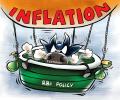
The RBI, which mainly factors in CPI for arriving at its bi-monthly monetary policy, has been mandated by the government to ensure that inflation remains at 4 per cent, with deviation of 2 per cent on either side.

To the extent that monetary variables affect investment, the weather, thus, looks far less clement.

The Index of Industrial Production (IIP) grew by 1.4 per cent in November as most components like manufacturing, electricity, mining, primary goods, and consumer durables witnessed a slowdown, according to data released by the National Statistical Office (NSO) on Wednesday. This is on the base of a decline of 1.7 per cent in November 2020 and before the new Covid variant started impacting economic activity. IIP growth was lower than the 4 per cent expansion recorded in the previous month but was better than a 1.6 per cent contraction seen in November 2020. Separately, rising prices of kitchen staples pushed retail inflation, or rate of price increase, to 5.59 per cent in December 2021, bringing it close to the upper band of Reserve Bank's comfort zone.

GDP growth in November is the second-highest since January 2012 when it had expanded 5.7%.
